
Product-water interface
Water Treatment to Bottling Integration
Define what the filling section must receive from treated-water storage and transfer - and what happens when that condition is not available.
Decision focus
What must cross this boundary, under which condition, who owns the response, and what evidence closes the interface?
01
Direct Answer
The treatment-to-bottling boundary is ready only when water condition, usable supply, storage and transfer behavior, sanitary connection, machine permissives, interruption response and verification evidence are agreed on one operating basis.
02
Position in the System
This boundary sits between the project-specific treated-water system and the rinsing-filling-capping section. This page does not design the source-water treatment plant; it defines the terminal conditions that the connected bottling equipment needs.
03
Buyer Inputs
- Raw-water analysis status and finished-water objective.
- Required saleable output and operating schedule on the intended bottle basis.
- Treated-water storage, transfer and recirculation concept, if already defined.
- Filler inlet requirements, connection drawing and permitted interruption behavior.
- Available utility, cleaning and quality-monitoring information at the equipment boundary.
04
Interface Map
One controlled record for the physical, process, utility, control and evidence boundary.
SystemInterfaceCard
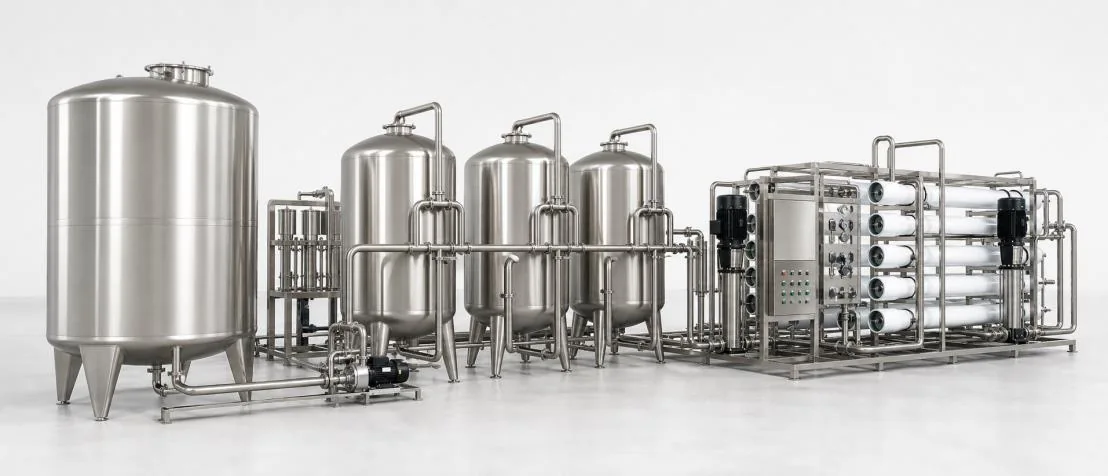
Treated-water delivery to rinsing-filling-capping
- Upstream system
- Treated-water storage and transfer
- Downstream system
- Rinsing-filling-capping section
- Transferred material
- Project-confirmed treated product water
- Physical connection
- Sanitary product-water connection and agreed tie-in boundary
- Required condition
- Confirmed water condition and usable supply at the filler inlet on the same operating basis
- Utility requirement
- Machine terminal conditions and cleaning needs from approved equipment sheets
- Control signal
- Availability, demand, permissive, low-condition, stop and restart signals as agreed
- Failure response
- Hold or stop the affected operation in a defined state; protect product condition and restart only after agreed permissives return
- Evidence required
- Water objective, analysis, connection drawing, supplier sheets, signal list and witnessed interface test record
Equipment Context at This Boundary
05
Main Design Decisions
Common operating basis
Compare treatment net supply and filler demand using the same product, time and operating assumptions.
Storage and transfer behavior
Define levels, pump demand, recirculation, stop response and restart conditions before control logic is frozen.
Hygienic boundary
Record the connection, materials, drainability, cleaning responsibility and sample or quality-check points that apply.
Evidence at the handoff
Agree which readings, records and tests demonstrate the required condition at the equipment inlet.
06
Trade-offs to Resolve
More storage vs. more hold-up
Additional storage may decouple short interruptions, while also increasing product hold-up and cleaning considerations. The project basis decides the balance.
Simple permissive vs. richer state exchange
A simple contact can be easier to integrate; more state information can support clearer diagnosis. Either approach needs explicit failure behavior.
07
Common Failure Modes
These are realistic review scenarios, not claims about a completed project.
- Treatment and filler rates are quoted on different or undefined bases.
- Storage levels or pump states do not propagate a usable permissive to the filler.
- A supply interruption stops production without a defined product-hold and restart rule.
- Connection, cleaning or sampling responsibilities remain implicit between suppliers.
08
Required Documents
- Raw-water analysis and finished-water requirement.
- Water-system flow diagram and control narrative.
- Filler product-water inlet and cleaning requirements.
- Connection drawing, utility sheets and approved signal list.
- Interface verification plan and result record.
09
Questions to Ask Before Quotation
- On what water, bottle and operating basis are the upstream and downstream duties stated?
- Which equipment owns demand, low-level, unavailable, hold and restart decisions?
- What protects product condition during an interruption?
- What evidence will confirm the required condition at the filler inlet?
Project-Specific Confirmation
Treatment selection must follow the actual raw-water analysis, finished-water objective, applicable requirements and connected-equipment data. The catalog illustrates selectable treatment categories; it does not establish a universal treatment train.
11
Related System Pages
Turn the unknowns into a reviewable interface
Review This Interface
Share the available bottle, output, site, utility and supplier evidence. Open items can remain explicitly marked for confirmation.