
Container interface
Bottle Blowing and Filling Integration
Match bottle supply to filler demand through an explicit mechanical, container-quality and control handoff.
Decision focus
What must cross this boundary, under which condition, who owns the response, and what evidence closes the interface?
01
Direct Answer
Blowing and filling are integrated when the agreed bottle arrives in the required orientation and condition, the transfer can respond to starved and blocked states, and both suppliers use the same bottle, output and test basis.
02
Position in the System
This interface begins at the bottle-supply or blowing discharge and ends at the filling-section infeed. It covers the bottle handoff, not a catalog comparison of blower or filling-machine models.
03
Buyer Inputs
- Bottle drawing, material, neck finish, closure and approved reference samples.
- Bottle-supply method and existing blower or bottle-handling records.
- Sustainable upstream and downstream rates stated on the same bottle basis.
- Available transfer route, machine elevations, infeed geometry and site constraints.
- Utility sheets, machine-state list, signal list and desired acceptance evidence.
04
Interface Map
One controlled record for the physical, process, utility, control and evidence boundary.
SystemInterfaceCard
Empty-bottle supply to filling infeed
- Upstream system
- Bottle blowing or empty-bottle handling
- Downstream system
- Rinsing-filling-capping section
- Transferred material
- Approved empty bottle in the required orientation and condition
- Physical connection
- Project-specific bottle conveyor or transfer with confirmed neck/body handling
- Required condition
- Stable supply of acceptable bottles on a common reference-bottle and operating basis
- Utility requirement
- Confirmed machine and transfer utility terminal conditions from supplier sheets
- Control signal
- Ready, demand, starved, blocked, fault, stop, reset and restart states as agreed
- Failure response
- Prevent uncontrolled bottle build-up or empty running; stop in the agreed sequence and verify the transfer before restart
- Evidence required
- Bottle drawing and samples, transfer drawing, state/handshake matrix, supplier sheets and connected-run observations
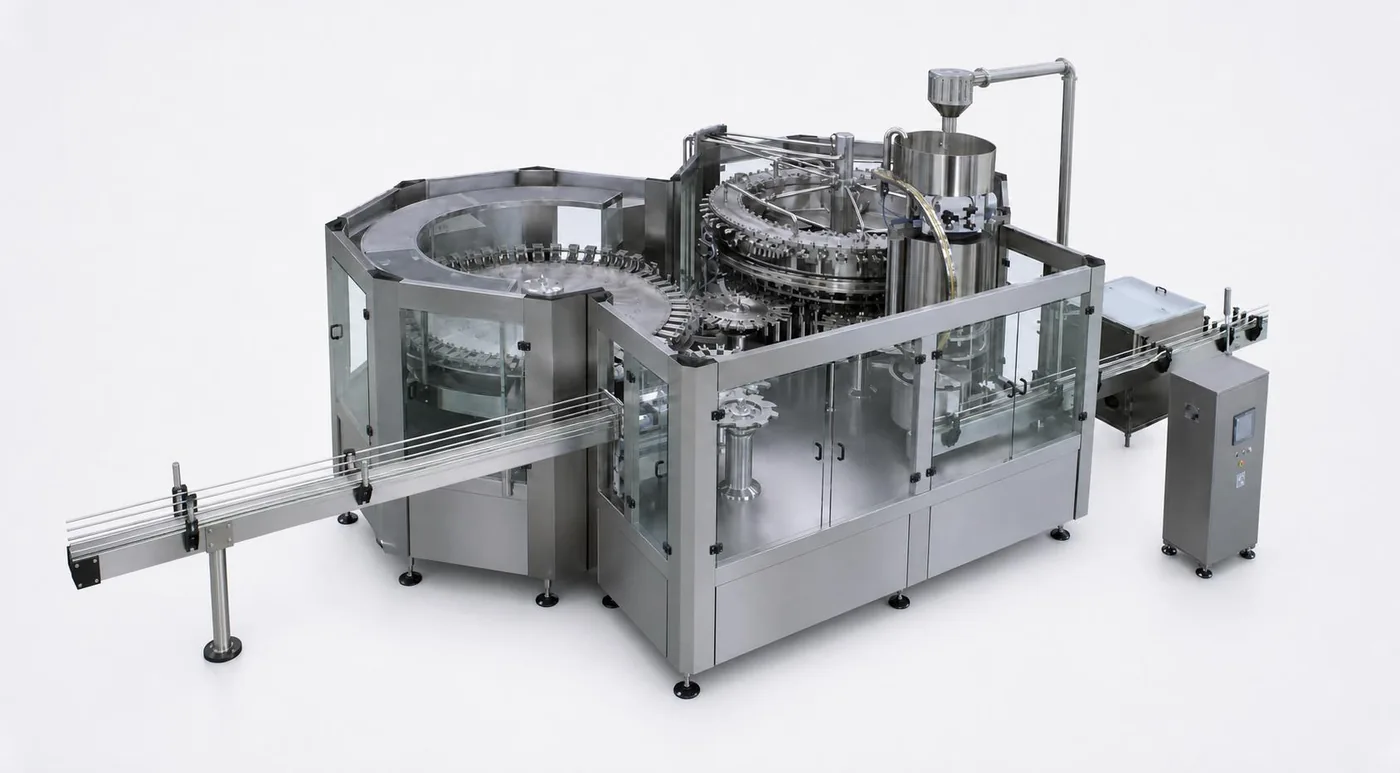
Equipment Context at This Boundary
05
Main Design Decisions
Reference bottle
Freeze the bottle and neck basis used for handling, infeed, change parts and testing.
Transfer method
Choose the transfer around bottle geometry, stability, elevation, distance and the interfaces supported by both machines.
State ownership
Define which machine requests bottles, detects blocked or starved conditions and initiates each stop or restart.
Quality at handoff
Agree observable acceptance checks for deformation, contamination, orientation and transfer damage.
06
Trade-offs to Resolve
Close coupling vs. decoupling
A short direct transfer can reduce handling steps; decoupling can isolate interruptions. Space, bottle stability and recovery behavior must be reviewed together.
Hardwired states vs. data exchange
The interface can remain simple or expose more diagnostics. Compatibility, ownership and safe behavior matter more than protocol preference.
07
Common Failure Modes
These are realistic review scenarios, not claims about a completed project.
- The bottle drawing used by one supplier differs from the approved filling/change-part basis.
- The transfer path handles the bottle inconsistently at curves, gaps or elevation changes.
- Blocked and starved states are detected locally but not communicated across the boundary.
- Restart occurs before bottles, conveyors and both machines return to a verified ready state.
08
Required Documents
- Approved bottle and neck drawing with reference samples.
- Equipment general arrangements and transfer-point drawing.
- Change-part, operating-state and alarm lists.
- Utility and electrical interface sheets.
- Bottle-handoff and connected-run evidence plan.
09
Questions to Ask Before Quotation
- Which approved bottle controls mechanical design and acceptance?
- How do both machines detect and exchange starved, blocked and fault conditions?
- What happens to bottles already in the transfer during a downstream stop?
- Which observations prove acceptable handoff and controlled restart?
Project-Specific Confirmation
Catalog references can illustrate bottle-infeed and filling categories, but the actual bottle geometry, handling method, rates, machine states and acceptance criteria must be confirmed by the project and connected suppliers.
11
Related System Pages
Turn the unknowns into a reviewable interface
Review This Interface
Share the available bottle, output, site, utility and supplier evidence. Open items can remain explicitly marked for confirmation.